断背山
When a Chinese mythic world travels without translation_我的网站

A | 太原8月26日电 (记者 李庭耀)“‘十五五’时期,我们将继续紧扣‘文商融合旅游热点门户’定位,把文旅流量转化为产业富民的增量。

B |

Chen Aijun works in an optical shop in Chengdu, southwest China's Sichuan Province, Aug. 14, 2026. (Xinhua/Lu Youyi)The video came with almost no instructions.
There was no narration explaining the mythology behind palaces rising above an ocean of clouds in the video, nor subtitles identifying the heavenly gates, cranes or tiny figures moving beneath them.
Yet viewers outside China quickly began naming the world for themselves.
Some called it "paradise." Others saw a "Celestial Palace" or an "Immortal Realm" familiar from Chinese fantasy games and television dramas. One user wrote, "Waiting on Wukong to show up," invoking the Monkey King from the Chinese literary classic "Journey to the West," or the hit game "Black Myth: Wukong."
The interpretations differed, but viewers did not seem to need the same cultural knowledge to enter the conversation.
Earlier this month, Chinese foreign ministry spokesperson Mao Ning shared the 33-second AI-generated video on social media with a question: "What does the Chinese heaven look like?"
It opened up a hermeneutic discussion, with responses overseas suggesting a cultural image does not necessarily need to elicit exactly the same interpretation for everyone in order for it to be viewed meaningfully.
"The right to interpret ultimately lies with the audience," said Zhang Zheng, deputy dean of Tsinghua University's School of Journalism and Communication.
People encountering unfamiliar cultures inevitably draw on what they already know, Zhang said. Rather than fully grasping every cultural reference, what matters is whether audiences can encounter the work, understand it and respond to it emotionally.
Before strangers abroad could interpret this particular world, however, it first had to get out of one man's head.
Chen Aijun, 34, is an optometrist in Chengdu, capital of southwest China's Sichuan Province.
By day, Chen leads a quiet, down-to-earth life in a neighborhood optical shop. Inside, he worked among eyeglass frames and optometry equipment. On his computer was another landscape entirely: cloud seas, immense palaces, flying cranes and figures in ancient robes.
Chen's heaven did not come from any single ancient text.
Growing up in the 1990s, he watched "Journey to the West" and later encountered "The Investiture of the Gods," xianxia (immortal heroes) novels and fantasy games. Those stories mixed over time with images of Chinese architecture and landscapes he saw online.
He has never visited nearby Mount Emei, and most of what he knows of Mount Huangshan's famous sea of clouds comes from videos.
What appeared on his screen was therefore not a reconstruction of one fixed mythological scene, but a world shaped by traditional stories already filtered through television, novels, games, the internet and his own memory.
For years, Chen had no way to make that world visible.
He never studied painting, design, photography or 3D modeling. After high school, he joined his parents' optical business and eventually took over the shop.
Generative AI changed the gap between imagining an image and possessing the technical skills to show it to someone else.
More than a year ago, Chen began teaching himself through free online tutorials. In September 2025, he started regularly posting AI videos, and a month later began experimenting with palaces floating above clouds. He has since published more than 200 videos.
The process, however, involves far more than entering a few prompts. The technology lowered the technical threshold, but it did not make the choices for him.
When creating Nantianmen, the mythical heavenly gate, Chen first defines the spatial rhythm and tonal hierarchy, pairing towering architecture and cloud seas with deliberately miniature figures to amplify the celestial realm's grand scale.
If the result does not match the picture in his mind, he tries again. He often generates over 1,000 images a day, revising a single scene repeatedly before moving on to animation, editing, color grading and music.
The machine can generate a thousand possible heavens. Chen still has to decide which one is his.
"AI-produced images can be soulless, and it takes human inspiration and aesthetic sensibility to endow works with warmth and vitality," he said.
Zhang believes Chen's experience reflects a broader shift brought about by generative AI. He said AI is giving people without conventional artistic training access to forms of expression that once required specialized skills. But what they create still depends on what they bring to the tool.
"A person's existing knowledge inevitably shapes how they use AI," Zhang said.
Chen brought his memories to the machine. Viewers abroad, in turn, brought theirs to the image.
"Everyone brings their own associations to these scenes," he said.
If his imagined world had to be reduced to three elements, he would keep clouds, architecture and people. The first two should feel immense, he said, while the last should remain small.
The details are culturally specific, but the visual effect is more immediate: tiny human figures dwarfed by vast clouds and monumental architecture. The responses suggest that viewers did not need to understand every cultural reference to find a way into the image.
Chen has no overseas social media accounts and learned that the video was attracting attention abroad only when friends sent him screenshots.
His life at the optical shop has changed little. He still checks eyesight and fits glasses when customers come in, then returns to his computer when the shop grows quiet.
He now hopes to make longer AI videos with fuller stories. He also wants to visit Mount Emei and, one day, Mount Huangshan.
For years, images of distant mountains and clouds reached Chen through screens. His imagined landscapes later traveled through screens to people he had never met.
Now he wants to see the real mountains and clouds for himself.
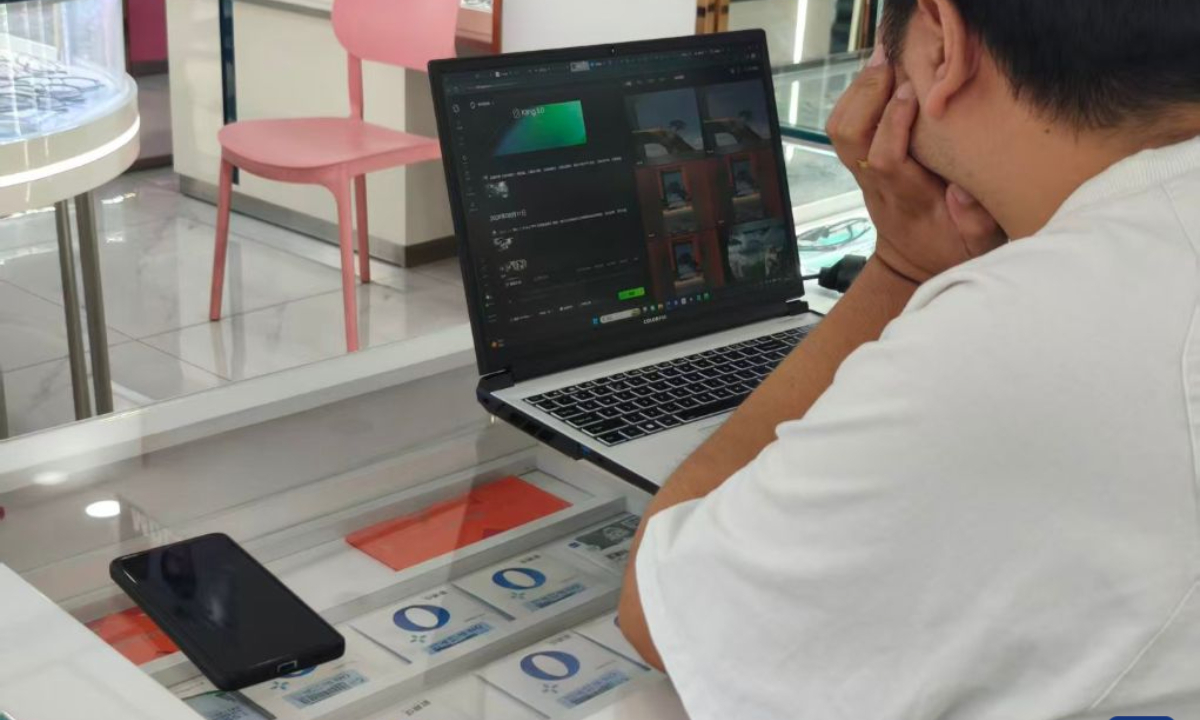
Chen Aijun makes AI videos in an optical shop in Chengdu, southwest China's Sichuan Province, Aug. 14, 2026. (Xinhua/Lu Youyi)
。”山西省运城市副市长张锐25日表示。

C | 运城被称作“国宝第一市”,关公文化、永乐宫壁画、运城盐湖等IP热度持续攀升。张锐介绍,“十四五”期间,运城文旅产业蓬勃发展,“国宝第一市”品牌影响力持续提升,接待人数、门票收入、综合收入年均增长都超过20%。今年春节,运城入境游增速175%,跻身全国前十;“五一”期间,运城抖音团购销售额增幅在全国三线及以下城市排名第一。 “以文引流,让国保‘活’起来。”张锐表示,运城将系统构建关公文化、池盐文化、黄河文化、根祖文化矩阵,创建国家文物保护利用示范区,加快绛州古城保护修复,推动西阴考古博物馆、永乐宫壁画博物馆建设,实施“国保开门”工程,让文化软实力成为产业硬支撑。

D | 同时,运城将创建盐湖国家级旅游度假区,加快七彩盐湖、22号堤埝等核心节点提升,让“死海”变“活景”;以关公故里创建5A级景区为牵引,建设世界级关公文化体验胜地;支持鹳雀楼、永乐宫、绛州古城等重点景区提档升级,形成“龙头带动、全域支撑”新格局。 坚持以商增值,让游客“留下来”。运城将大力发展赛事经济、微短剧经济,推出“跟着赛事去旅行”“跟着短剧去旅行”系列活动。做强“运城礼物”文创品牌,培育“首店、首秀、首演”,打造更多国货潮品,让游客把“国宝第一市”的故事带回家。

E | 张锐介绍,运城将推动文旅与科技、工业、康养、体育、教育深度融合,运用AR/VR打造沉浸式体验;发展露营经济、后备箱集市等新场景,吸引年轻客群,让运城成为人们向往的“好运之城”。
Current article:http://urem.zangjiwuqihuncongcherua.cyou/bp0/n9y3v.html
Published on:14:46:08